The Power of Compounding: Turn $100/Month into Significant Wealth in 20 Years
Anúncios
In the world of finance, there are few concepts as universally praised and yet often underestimated as the power of compounding. Often referred to as the ‘eighth wonder of the world’ by Albert Einstein, compound interest is the phenomenon where your investment earnings also earn returns, leading to exponential growth over time. This article delves into how starting with a seemingly modest sum of just $100 per month can, through the magic of compound interest wealth, lead to significant financial security over a 20-year horizon. It’s a journey from small, consistent contributions to a robust financial future, demonstrating that you don’t need a massive initial capital to begin building substantial wealth.
Many people believe that investing is only for the wealthy, or that you need thousands of dollars to see any meaningful returns. This misconception often deters individuals from starting their investment journey early. However, the truth is quite the opposite. The real secret to successful investing, especially for long-term goals, lies in consistency and the incredible effect of compound interest. Even a small, regular contribution like $100 a month, when given enough time, can accumulate into a surprisingly large sum. This isn’t just about saving money; it’s about making your money work for you, earning returns on both your principal and the accumulated interest, thereby creating compound interest wealth.
Anúncios
This comprehensive guide will walk you through the mechanics of compound interest, illustrate its potential with practical examples, and provide actionable steps to help you start your own journey towards financial independence. We will explore various investment vehicles suitable for small, regular contributions, discuss the importance of starting early, and address common misconceptions. By the end of this article, you will have a clear understanding of how to harness the power of compound interest to build significant wealth over the next two decades.
Understanding the Basics of Compound Interest Wealth
Before we dive into the numbers, let’s solidify our understanding of compound interest. Simply put, compound interest is interest calculated on the initial principal, which also includes all of the accumulated interest from previous periods on a deposit or loan. It’s often contrasted with simple interest, which is calculated only on the principal amount. The key difference is that with compound interest, your earnings start earning their own returns, creating a snowball effect. This effect is crucial for building compound interest wealth.
Anúncios
Imagine you invest $1,000 at a 5% annual interest rate. With simple interest, you would earn $50 each year, and after 10 years, you’d have $1,500. With compound interest, however, the first year you earn $50, bringing your total to $1,050. In the second year, you earn 5% on $1,050, which is $52.50, and so on. Each year, the base upon which interest is calculated grows larger, accelerating your wealth accumulation. This seemingly small difference becomes monumental over longer periods, which is why time is your greatest ally when leveraging compound interest wealth.
The formula for compound interest is: A = P (1 + r/n)^(nt)
- A = the future value of the investment/loan, including interest
- P = the principal investment amount (the initial deposit or loan amount)
- r = the annual interest rate (as a decimal)
- n = the number of times that interest is compounded per year
- t = the number of years the money is invested or borrowed for
While this formula might look intimidating, the core concept is simple: the more frequently your interest is compounded and the longer your money remains invested, the more significant your returns will be. This principle is fundamental to achieving compound interest wealth.
The $100 per Month Challenge: A 20-Year Projection for Compound Interest Wealth
Now, let’s apply this principle to our scenario: investing $100 per month consistently for 20 years. To make this projection realistic, we need to consider an average annual return rate. Historically, the stock market (represented by indices like the S&P 500) has delivered average annual returns of around 7-10% over long periods, adjusted for inflation. For a conservative estimate, let’s use an average annual return of 7%.
Over 20 years, you will have contributed a total of $100/month * 12 months/year * 20 years = $24,000 of your own money. This is a significant sum in itself, demonstrating the power of consistent saving. However, the real magic happens when compound interest wealth kicks in.
Let’s break down the potential growth:
Year 1-5: The Foundation Phase
In the initial years, the growth might seem slow. Your contributions are the primary driver of your portfolio’s size. After five years, you would have contributed $6,000. With a 7% annual return, your investment could be worth approximately $7,150. While a gain of $1,150 in interest isn’t life-changing, it’s a solid start and establishes the foundation for future compound interest wealth.
Year 6-10: Building Momentum
As time progresses, the compounding effect becomes more noticeable. By the end of 10 years, your total contributions would be $12,000. At a 7% annual return, your investment could grow to roughly $17,300. In this phase, you’ve earned approximately $5,300 in interest alone, showing a significant acceleration compared to the first five years. This is where the power of compound interest wealth truly begins to show its potential.
Year 11-20: The Exponential Leap for Compound Interest Wealth
This is where compound interest truly shines. By the end of 20 years, your total contributions will be $24,000. With a consistent 7% annual return, your investment could reach an astonishing $52,000 to $54,000. This means that over half of your total accumulated wealth would be from interest earned on your principal and previous interest payments. You would have more than doubled your initial contributions through the sheer force of compounding. This illustrates the profound impact of compound interest wealth over the long term.
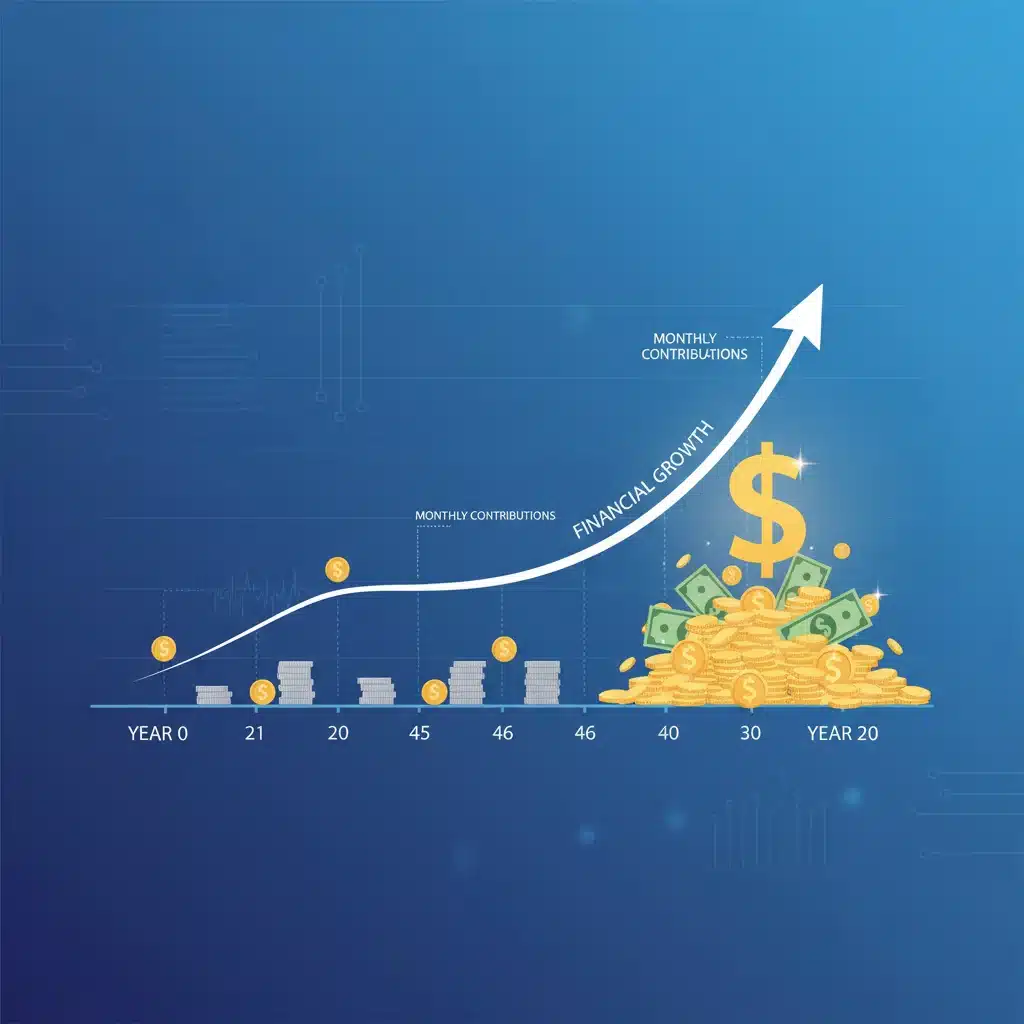
These figures are estimates and can vary based on actual market performance, fees, and inflation. However, they powerfully demonstrate that consistent, long-term investing, even with small amounts, can lead to substantial compound interest wealth. The key takeaway is that the longer your money has to grow, the more impact compounding has.
The Critical Role of Time and Consistency in Building Compound Interest Wealth
The examples above highlight two crucial elements for maximizing compound interest wealth: time and consistency. Starting early gives your money more time to compound, allowing even small contributions to grow into significant sums. Delaying your investment journey, even by a few years, can dramatically reduce your potential returns.
The Early Bird Gets the Worm (and More Interest)
Consider two individuals, Alice and Bob, both investing $100 per month at a 7% annual return. Alice starts at age 25 and invests for 10 years, then stops. Bob starts at age 35 and invests for 20 years. Despite Bob investing for twice as long and contributing more overall, Alice’s money, which had a head start, will likely accumulate more wealth by the time they both reach retirement age (say, 65). This is because Alice’s initial contributions had more time to compound, demonstrating the immense advantage of starting early for compound interest wealth.
Consistency is Key
Life happens, and sometimes it can be tempting to skip a month’s investment or withdraw funds for an immediate need. However, consistency is paramount. Regular contributions ensure that you are continuously adding to your principal, giving more money the opportunity to compound. Automating your investments, by setting up an automatic transfer from your checking account to your investment account each month, is an excellent strategy to maintain this consistency and build compound interest wealth without having to think about it.
Choosing the Right Investment Vehicles for Your $100 Monthly Contribution to Compound Interest Wealth
With just $100 a month, you might wonder what investment options are available. Fortunately, there are several accessible and effective vehicles that allow you to harness compound interest wealth.
1. Low-Cost Index Funds and ETFs
These are often recommended for beginners and experienced investors alike due to their diversification and low fees. An index fund or Exchange Traded Fund (ETF) tracks a specific market index, like the S&P 500, giving you exposure to hundreds or thousands of companies with a single investment. Many brokerages offer fractional shares, meaning you can invest your full $100 even if the price of one share is higher. This is an excellent way to tap into the broad market for compound interest wealth.
2. Robo-Advisors
If you prefer a hands-off approach, robo-advisors are a fantastic option. These platforms use algorithms to manage your investments based on your financial goals and risk tolerance. They typically have low minimums, low fees, and automatically rebalance your portfolio, making them ideal for consistent monthly contributions. Platforms like Betterment or Acorns can help you start building compound interest wealth with ease.
3. Retirement Accounts (Roth IRA/Traditional IRA)
If you’re investing for retirement, a Roth IRA or Traditional IRA is highly recommended. These accounts offer significant tax advantages. With a Roth IRA, your contributions are made with after-tax dollars, but your qualified withdrawals in retirement are completely tax-free. A Traditional IRA offers tax-deductible contributions, but withdrawals in retirement are taxed. Both allow your investments to grow tax-deferred or tax-free, significantly boosting your compound interest wealth. The annual contribution limit for IRAs is $6,500 for 2023, so $100 a month is well within this limit.
4. High-Yield Savings Accounts (HYSA) or Certificates of Deposit (CDs)
While not providing the same growth potential as the stock market, HYSAs and CDs offer a safer option for a portion of your savings, especially for shorter-term goals or emergency funds. They provide higher interest rates than traditional savings accounts, allowing you to earn some compound interest wealth with minimal risk. However, for long-term wealth building over 20 years, market-based investments are generally more effective.
It’s crucial to research and choose investment vehicles that align with your risk tolerance and financial goals. Diversification across different asset classes can also help mitigate risk and enhance your overall compound interest wealth accumulation.
Practical Steps to Start Your $100 Monthly Investment Journey Towards Compound Interest Wealth
Ready to put the power of compounding to work for you? Here are practical steps to get started:
1. Create a Budget and Find Your $100
The first step is to identify where you can free up $100 in your monthly budget. This might involve cutting down on discretionary spending like daily coffees, eating out less frequently, or reviewing subscriptions you no longer use. Even small adjustments can add up. The goal is to make this $100 a non-negotiable part of your financial plan, dedicated to building compound interest wealth.
2. Open an Investment Account
Choose a reputable brokerage firm or robo-advisor. Many platforms cater to beginners and offer low minimums. Consider factors like fees, available investment options, and user-friendliness. For instance, Fidelity, Vanguard, Charles Schwab, Betterment, and Acorns are popular choices that can facilitate your journey to compound interest wealth.
3. Choose Your Investments
As discussed, low-cost index funds, ETFs, or a diversified portfolio managed by a robo-advisor are excellent starting points. If you’re unsure, a target-date fund within a retirement account can also be a good option as it automatically adjusts its asset allocation over time. The key is to select investments that align with your risk tolerance and long-term goals for compound interest wealth.
4. Automate Your Contributions
Set up an automatic transfer of $100 from your bank account to your investment account each month, ideally on payday. This ensures consistency and removes the temptation to spend the money elsewhere. Automation is a powerful tool for building compound interest wealth.
5. Stay Invested and Be Patient
Market fluctuations are normal. There will be ups and downs. The most important thing is to avoid panic selling during downturns. Remember that compound interest wealth is a long-term game. Stay disciplined, continue your regular contributions, and trust in the power of time and compounding.

Overcoming Common Obstacles to Building Compound Interest Wealth
While the concept of compound interest wealth is straightforward, sticking to an investment plan for two decades can present challenges. Here are some common obstacles and how to overcome them:
1. Inflation
Inflation erodes the purchasing power of money over time. A dollar today won’t buy as much in 20 years. When calculating potential returns, it’s important to consider inflation. Historically, the stock market has outpaced inflation, making it a good hedge against it. By aiming for real returns (returns after inflation), you ensure your compound interest wealth maintains its value.
2. Market Volatility
The stock market can be volatile, experiencing periods of significant gains and losses. It’s natural to feel anxious during downturns. However, for long-term investors, market corrections can be opportunities to buy more assets at lower prices. Remember that you are investing for 20 years, and short-term fluctuations are less relevant than the overall long-term trend. Maintaining a diversified portfolio also helps to mitigate the impact of volatility on your compound interest wealth.
3. Investment Fees
Fees, even seemingly small ones, can significantly eat into your returns over 20 years. Choose low-cost index funds, ETFs, and brokerages with competitive fee structures. Be wary of actively managed funds with high expense ratios, as they often underperform their passively managed counterparts after fees. Minimizing fees is crucial for maximizing your compound interest wealth.
4. Lifestyle Creep
As your income grows, there’s a tendency to increase your spending proportionally. This ‘lifestyle creep’ can make it difficult to maintain your $100 monthly investment or increase it over time. Consciously resist lifestyle creep and prioritize increasing your investments as your income rises. This allows you to accelerate the growth of your compound interest wealth.
5. Lack of Financial Education
Many people shy away from investing because they feel they don’t understand it. However, you don’t need to be a financial expert to start. Begin by learning the basics, reading reputable financial blogs and books, and asking questions. The more you understand, the more confident you’ll become in managing your investments and building compound interest wealth.
Advanced Strategies to Supercharge Your Compound Interest Wealth
Once you’ve mastered the basics and are consistently investing $100 a month, consider these strategies to further accelerate your compound interest wealth:
1. Increase Contributions Over Time
As your income grows, aim to increase your monthly investment amount. Even an extra $25 or $50 a month can make a significant difference over two decades. The more you contribute, the more principal you have compounding, leading to faster wealth accumulation.
2. Reinvest Dividends
Many stocks and funds pay dividends. Ensure that your investment account is set to automatically reinvest these dividends. This means the dividends are used to buy more shares, which then generate their own dividends, creating an even more powerful compounding effect. This is a passive yet effective way to boost your compound interest wealth.
3. Diversify Your Portfolio
While index funds offer broad diversification, you might consider adding other asset classes as your portfolio grows, such as bonds or real estate (through REITs). Diversification helps spread risk and can enhance returns. A well-diversified portfolio is more resilient to market downturns and contributes to stable compound interest wealth.
4. Tax-Loss Harvesting (for taxable accounts)
If you invest in a taxable brokerage account, tax-loss harvesting can be a valuable strategy. This involves selling investments at a loss to offset capital gains and potentially reduce your taxable income. While more advanced, it can improve your after-tax returns and contribute to your overall compound interest wealth.
5. Monitor and Adjust (but don’t over-manage)
Periodically review your portfolio (e.g., once a year) to ensure it still aligns with your goals and risk tolerance. You might need to rebalance if certain asset classes have grown significantly. However, avoid constant tinkering; excessive trading can lead to higher fees and missed opportunities. A ‘set it and forget it’ approach, with occasional check-ins, is often best for long-term compound interest wealth.
The Psychological Benefits of Building Compound Interest Wealth
Beyond the financial gains, consistently investing and seeing your money grow through compound interest offers significant psychological benefits:
1. Sense of Control and Empowerment
Taking active steps to manage your finances and build wealth provides a strong sense of control over your future. It empowers you to make informed decisions and reduces financial anxiety. Knowing you are actively building compound interest wealth can be incredibly liberating.
2. Reduced Financial Stress
As your investment portfolio grows, so does your financial safety net. This can significantly reduce stress related to unexpected expenses, retirement planning, or future financial goals. The peace of mind that comes with growing compound interest wealth is invaluable.
3. Achieving Financial Freedom
Ultimately, the goal for many is financial freedom – the ability to make life choices without being constrained by money. Building compound interest wealth systematically over two decades brings you considerably closer to this goal, opening up opportunities for early retirement, career changes, or pursuing passions.
4. A Legacy for the Future
The wealth you build can extend beyond your own needs. It can provide a legacy for your children, support causes you believe in, or create opportunities for future generations. The long-term nature of compound interest wealth building makes this possible.
Conclusion: Unleash Your Compound Interest Wealth Potential
The journey to significant wealth doesn’t always begin with a large inheritance or a high-paying job. For many, it starts with a simple, consistent commitment to saving and investing, harnessing the unparalleled power of compound interest. As we’ve explored, starting with just $100 per month and maintaining that discipline over 20 years can transform a modest stream of contributions into a substantial sum, providing a strong foundation for your financial future. This is the essence of building compound interest wealth.
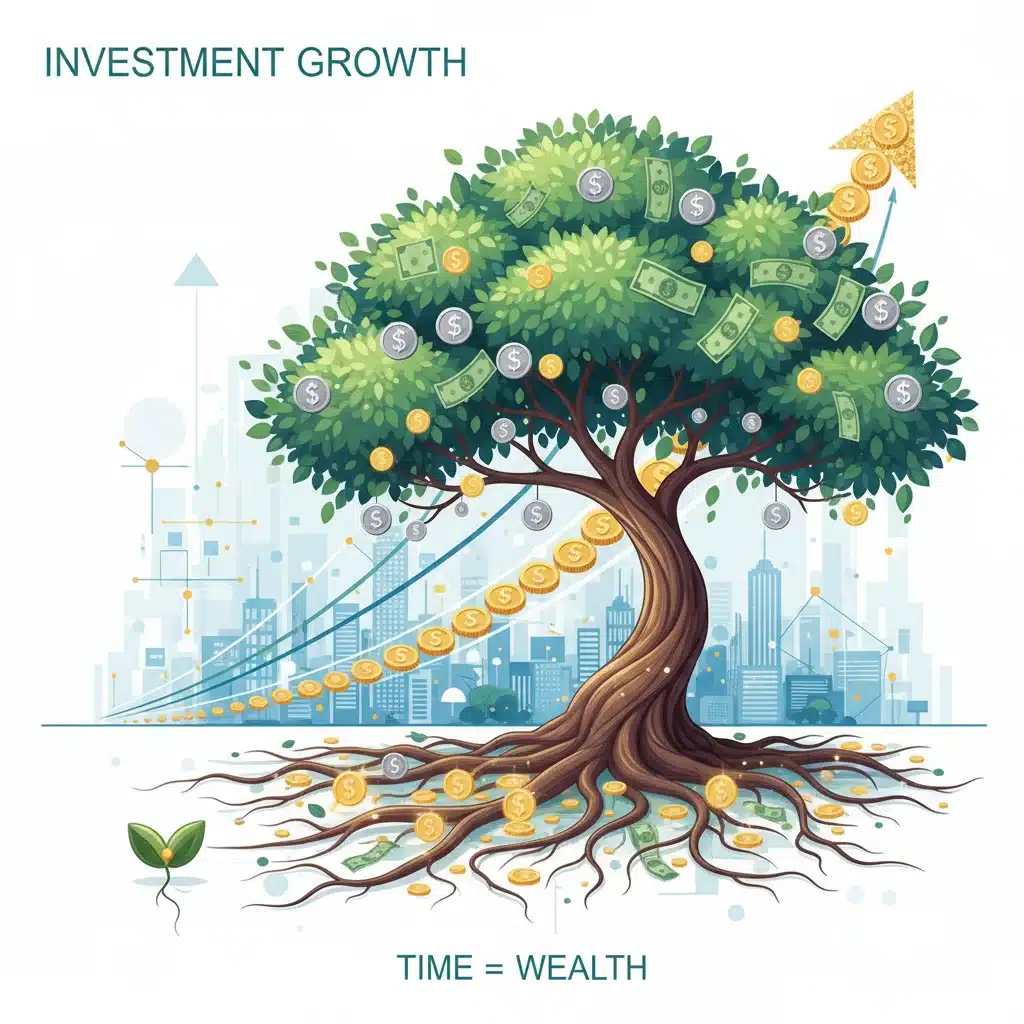
The key takeaways are clear: start early, stay consistent, choose low-cost diversified investments, and be patient. Time is your greatest asset when it comes to compounding. Don’t underestimate the potential of small, regular actions to create monumental results over the long term. The $100 per month you invest today isn’t just $100; it’s a seed you’re planting that, with time and consistency, will grow into a flourishing tree of compound interest wealth.
So, take the first step today. Review your budget, open that investment account, automate your contributions, and embark on a rewarding 20-year journey towards financial independence. The power of compounding is waiting to work its magic for you. Your future self will thank you for unleashing your compound interest wealth potential.