The 2026 Guide to Understanding Investment Fees: Saving 0.5% Annually Can Add $5,000 to Your Portfolio
In the complex world of investments, many factors influence your financial success: market performance, asset allocation, diversification, and your personal risk tolerance. However, one often-overlooked yet profoundly impactful element is investment fees impact. While seemingly small percentages, these fees can quietly erode a significant portion of your returns over time, ultimately costing you thousands, or even tens of thousands, of dollars. As we look towards 2026 and beyond, understanding and actively managing these costs is more crucial than ever for optimizing your financial future.
Anúncios
Imagine this: you’re diligently saving and investing for retirement, contributing regularly to your portfolio. You see modest returns year after year, feeling confident in your long-term plan. What you might not realize is that a seemingly innocuous 0.5% in annual fees could be shaving off a substantial chunk of your potential wealth. This isn’t just a hypothetical scenario; it’s a financial reality for many investors. This comprehensive guide will illuminate the various types of investment fees, demonstrate their profound impact with real-world examples, and equip you with actionable strategies to minimize them, potentially adding $5,000 or more to your portfolio annually. Let’s delve into how a keen understanding of investment fees impact can transform your financial trajectory.
The Silent Wealth Eroder: What Are Investment Fees?
Before we dissect their impact, let’s define what investment fees are. In essence, these are the costs associated with managing your investments. They can come in various forms, charged by different entities, and often hide in plain sight within complex financial statements. Understanding each type is the first step toward effective fee management and maximizing your returns.
Types of Investment Fees: A Detailed Breakdown
The landscape of investment fees is diverse. Here are the most common types you’ll encounter:
Anúncios
- Expense Ratios (Management Fees): This is arguably the most common fee, particularly for mutual funds and Exchange Traded Funds (ETFs). The expense ratio represents the annual percentage of your investment that goes towards covering the fund’s operating expenses, including portfolio management, administrative costs, and marketing. A fund with a 1.0% expense ratio means that for every $10,000 you have invested, $100 is deducted annually, regardless of performance. This is a crucial area where investment fees impact is felt most directly.
- Trading Fees (Commissions): These are charges incurred when you buy or sell investments, such as stocks, ETFs, or mutual funds. While many online brokers have moved to commission-free trading for stocks and ETFs, some mutual funds or specialized investments may still carry these charges. High trading activity can quickly accumulate significant costs.
- Advisory Fees: If you work with a financial advisor, they typically charge a fee for their services. This can be a percentage of assets under management (AUM), a flat fee, or an hourly rate. A common AUM fee is 1% annually, meaning an advisor managing a $100,000 portfolio would charge $1,000 per year.
- Load Fees (Sales Charges): Specific to some mutual funds, load fees are commissions paid to brokers or advisors.
- Front-end load: Paid when you purchase the fund (e.g., 3-5% of your investment). This means if you invest $10,000 with a 5% front-end load, only $9,500 is actually invested.
- Back-end load (Deferred Sales Charge): Paid when you sell the fund, often decreasing over time the longer you hold the investment.
- No-load funds: Do not charge these sales commissions.
- 12b-1 Fees: These are annual marketing and distribution fees charged by some mutual funds, usually ranging from 0.25% to 1.00% of the fund’s assets. They are included in the expense ratio.
- Account Maintenance Fees: Some brokerage firms or financial institutions charge annual fees for maintaining your investment account, especially if it falls below a certain balance.
- Transaction Fees: Distinct from commissions, these might be charged for wire transfers, paper statements, or exercising options.
Each of these fees, individually or in combination, can chip away at your returns. Understanding where they come from is the first critical step in mitigating their effect on your long-term wealth.
The Compounding Cost: How 0.5% Can Cost You Thousands
Now, let’s get to the heart of the matter: the quantifiable impact of these fees. It’s easy to dismiss 0.5% or 1% as small figures, but thanks to the power of compounding (which works both for and against you), these seemingly minor percentages can lead to a staggering difference in your portfolio’s value over decades. This is where the true investment fees impact becomes evident.
A Hypothetical Scenario: The Power of 0.5%
Let’s consider two investors, Sarah and John, both 30 years old, investing $500 per month for 35 years until retirement at age 65. Both achieve an average annual gross return of 7% before fees. The only difference? Sarah pays 1.0% in annual fees, while John, through careful selection, pays only 0.5%.
| Variable | Sarah (1.0% Fees) | John (0.5% Fees) |
|---|---|---|
| Monthly Contribution | $500 | $500 |
| Investment Period | 35 years | 35 years |
| Gross Annual Return | 7.0% | 7.0% |
| Net Annual Return | 6.0% | 6.5% |
| Total Contributions | $210,000 | $210,000 |
| Estimated Portfolio Value at 65 | ~$655,000 | ~$755,000 |
| Difference in Portfolio Value | – | ~$100,000 |
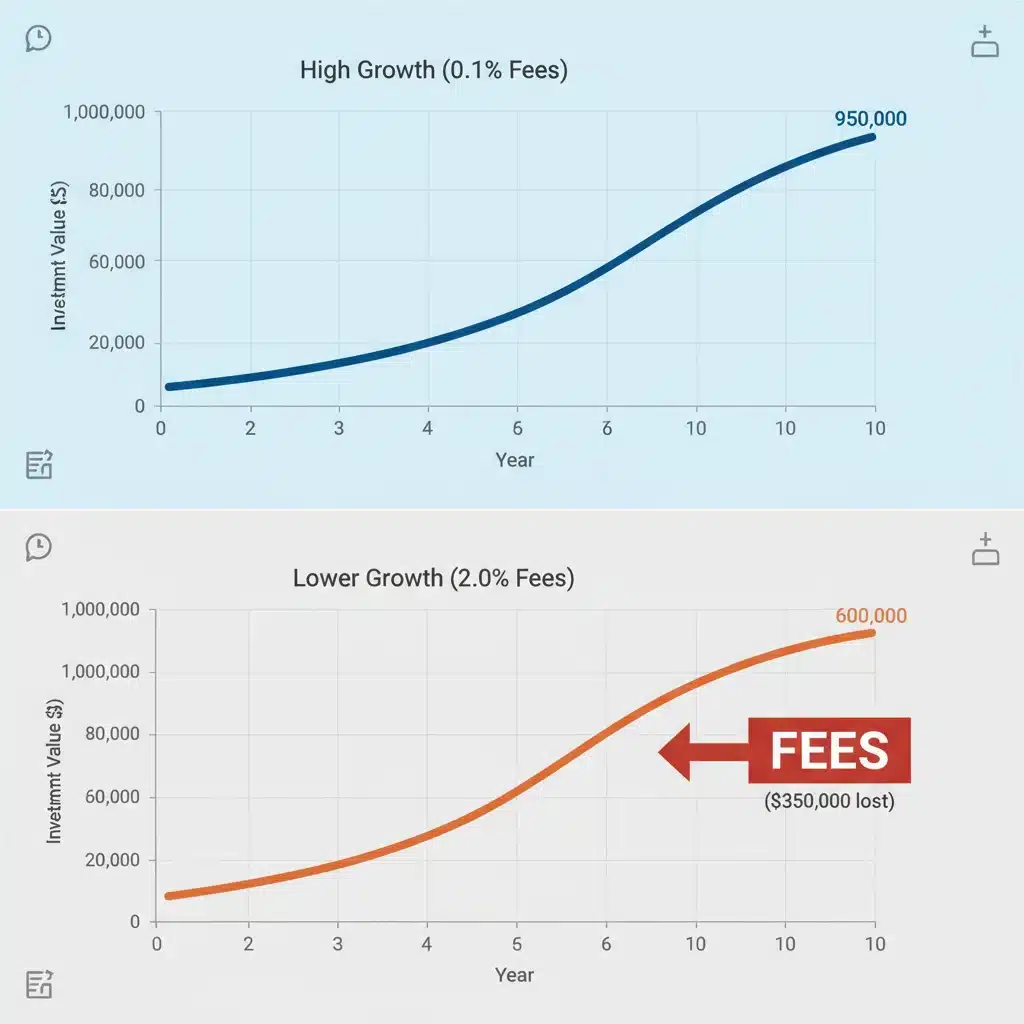
This simple 0.5% difference in fees results in a staggering $100,000 difference in their retirement nest eggs! And this is just by saving 0.5% annually. Imagine the impact if you save even more. This powerful illustration underscores why understanding and minimizing investment fees impact is not just good practice, but absolutely essential for long-term wealth accumulation.
The $5,000 annual gain mentioned in the title might seem ambitious from a 0.5% difference, but this is an average over a long period. In the later years of a large portfolio, 0.5% of a substantial sum can indeed equate to thousands of dollars in annual savings, directly contributing to your portfolio’s growth.
Strategies to Mitigate Investment Fees in 2026
Now that we’ve established the significant investment fees impact, the next logical step is to explore how you can actively reduce them. Fortunately, with the evolution of financial products and services, investors have more options than ever to keep costs low.
1. Opt for Low-Cost Index Funds and ETFs
One of the most effective ways to minimize expense ratios is to choose passively managed index funds or ETFs. These funds aim to track a specific market index (like the S&P 500) rather than trying to beat it. Because they require less active management, their expense ratios are significantly lower, often ranging from 0.03% to 0.20%, compared to actively managed funds that can charge 0.5% to 2.0% or more. This strategic choice alone can dramatically reduce your investment fees impact.
- Example: Instead of an S&P 500 actively managed mutual fund with a 0.8% expense ratio, consider an S&P 500 index ETF with a 0.05% expense ratio. The difference of 0.75% annually is substantial over decades.
2. Choose Commission-Free Brokers
Many online brokerage platforms now offer commission-free trading for stocks, ETFs, and even some mutual funds. By choosing such a broker, you can eliminate trading fees, especially if you plan to rebalance your portfolio regularly or invest in individual stocks. Always read the fine print, as some ‘commission-free’ platforms might have other hidden charges.
3. Be Wary of Load Funds
As discussed, load funds charge a sales commission. For most retail investors, especially those managing their own portfolios or using fee-only advisors, these are generally unnecessary costs. Opt for no-load mutual funds whenever possible. Your money should be working for you, not for a salesperson’s commission.
4. Scrutinize Advisory Fees
If you use a financial advisor, understand their fee structure. A fee-only advisor who charges a flat rate or an hourly fee might be more cost-effective than one who charges a percentage of AUM, especially as your portfolio grows. For a $1 million portfolio, a 1% AUM fee is $10,000 annually. A flat fee of $5,000 might be a better deal if the services are comparable. Always ask for a clear breakdown of all costs. The goal is to ensure the value provided by the advisor significantly outweighs the investment fees impact they charge.
5. Consolidate Accounts
Having multiple investment accounts across different institutions can lead to various account maintenance fees or minimum balance requirements. Consolidating your accounts under one or two low-cost providers can simplify management and reduce overall fees. This also makes tracking your total investment fees impact much easier.
6. Understand Your 401(k) and Retirement Plan Fees
Employer-sponsored retirement plans, like 401(k)s, can also come with a range of fees, including administrative fees, record-keeping fees, and investment management fees for the funds offered. While you might not have as much control over the plan’s overall structure, you can often choose lower-cost investment options within the plan. Review your plan documents (often called a ‘fee disclosure statement’) carefully to identify these costs and select the most cost-efficient funds available.
7. Avoid Unnecessary Trading
Frequent buying and selling, often referred to as ‘churning’ or market timing, not only increases your risk but also racks up trading fees and potential capital gains taxes. A long-term, buy-and-hold strategy, coupled with periodic rebalancing, is generally more cost-effective and often leads to better returns, significantly reducing the negative investment fees impact from transactional costs.
8. Read the Fine Print (Prospectus and Fee Schedules)
This cannot be stressed enough. Before investing in any fund or opening an account, thoroughly read the prospectus and the fee schedule. These documents, though dense, contain all the information about the fees you will be charged. If something isn’t clear, ask for clarification. Knowledge is power, especially when it comes to protecting your money from unnecessary expenses.
Calculating Your Personal Investment Fees Impact
To truly grasp the effect of fees on your personal portfolio, it’s essential to perform your own calculations. Many online calculators can help you visualize the long-term difference. Here’s a simplified approach:
- Identify all current fees: List every fee you pay – expense ratios, advisory fees, account fees, etc.
- Calculate total annual fee percentage: Sum these up as a percentage of your total assets.
- Project future growth: Use a compound interest calculator. Input your current portfolio value, expected annual contributions, estimated gross return, and then run the calculation twice: once with your current total fee percentage deducted from the gross return, and once with a hypothetical lower fee percentage (e.g., 0.5% lower). The difference will be eye-opening and clearly demonstrate your personal investment fees impact.
For example, if your current portfolio is $100,000, you contribute $6,000 annually, expect a 7% gross return, and pay 1.5% in fees (net 5.5%), compared to a scenario where you pay 0.75% in fees (net 6.25%). Over 20 years, the difference could easily be tens of thousands of dollars.

The Future of Investment Fees: Trends for 2026 and Beyond
The financial industry is constantly evolving, and the trend towards lower fees is likely to continue into 2026. Here’s what investors can expect:
- Continued Pressure on Expense Ratios: The fierce competition among fund providers, particularly in the ETF space, will likely drive expense ratios even lower. Zero-fee funds, once a novelty, might become more common for certain asset classes.
- Rise of Robo-Advisors: These automated investment platforms offer diversified portfolios at a fraction of the cost of traditional human advisors (typically 0.25% to 0.50% of AUM). Their accessibility and low fees will continue to attract cost-conscious investors.
- Transparency and Disclosure: Regulatory bodies are continually pushing for greater fee transparency. Investors in 2026 can expect clearer and more standardized disclosures, making it easier to identify and compare fees.
- Personalized Fee Structures: As AI and data analytics advance, some platforms might offer more personalized fee structures based on portfolio size, services used, or specific investment goals.
These trends empower investors to be even more diligent in managing their investment fees impact. The competitive landscape means that those who actively seek out low-cost options will be rewarded with significantly higher net returns.
Beyond Fees: The Holistic Approach to Investment Success
While minimizing fees is paramount, it’s crucial to remember that it’s just one piece of the puzzle. A truly successful investment strategy considers a holistic view:
- Asset Allocation: Ensure your portfolio’s mix of stocks, bonds, and other assets aligns with your risk tolerance and time horizon.
- Diversification: Spread your investments across different asset classes, industries, and geographies to reduce risk.
- Long-Term Perspective: Avoid emotional decisions driven by short-term market fluctuations. Stick to your plan.
- Tax Efficiency: Understand the tax implications of your investments and utilize tax-advantaged accounts (like 401(k)s, IRAs, HSAs) to maximize after-tax returns.
- Regular Review: Periodically review your portfolio, not just for performance but also for fees. Ensure your investments still align with your goals and that you’re not paying more than necessary.
By integrating fee awareness into these broader investment principles, you create a robust framework for long-term financial growth. The goal is not just to save on fees, but to ensure every dollar you invest is working as hard as possible for you.
Conclusion: Take Control of Your Investment Fees Impact
The message is clear: investment fees impact your financial future far more than most people realize. A seemingly small 0.5% annual difference in fees, compounded over decades, can easily translate into hundreds of thousands of dollars in your retirement account. As we move into 2026, the tools and knowledge to combat these silent wealth eradicators are more accessible than ever.
By actively choosing low-cost index funds and ETFs, opting for commission-free brokers, scrutinizing advisory fees, and understanding all the charges associated with your accounts, you put yourself in a powerful position. Don’t let inertia or ignorance cost you a significant portion of your hard-earned money. Take the time to review your current investments, understand their fee structures, and make informed decisions. Your future self, with a significantly larger portfolio, will thank you. Remember, every dollar saved in fees is a dollar earned for your future, directly contributing to your wealth and financial freedom.
Start today by identifying your current fees and exploring lower-cost alternatives. The difference you make by understanding and acting on investment fees impact could be the most significant financial decision you make this year.