Mastering FAFSA Changes 2026: Your Guide to Maximizing Financial Aid

Anúncios
Understanding the Latest FAFSA Changes for 2026: Maximizing Your Personal Financial Aid Eligibility
The landscape of financial aid for higher education is continuously evolving, and the Free Application for Federal Student Aid (FAFSA) is at the heart of these transformations. For students and families planning for the 2026-2027 academic year and beyond, understanding the upcoming FAFSA changes 2026 is not just beneficial—it’s essential for maximizing financial aid eligibility. These aren’t minor tweaks; they represent a significant overhaul designed to simplify the application process and expand aid access for many. However, with simplification often comes new complexities that require careful navigation.
This comprehensive guide will delve deep into the critical FAFSA changes 2026, breaking down what they mean for you. We’ll explore the shift from Expected Family Contribution (EFC) to the Student Aid Index (SAI), the new rules for reporting family farm and business assets, and the impact on divorced or separated parents. Our goal is to equip you with the knowledge and strategies needed to confidently approach the new FAFSA and secure the maximum financial aid possible for your educational journey. Let’s embark on this journey to demystify the FAFSA changes 2026 and empower your financial aid planning.
Anúncios
The Evolution of FAFSA: Why the Changes?
The FAFSA has been a cornerstone of federal student aid for decades, but its complexity has often been a barrier for many families. The FAFSA Simplification Act, passed by Congress, aims to address these long-standing issues. The primary motivations behind the FAFSA changes 2026 include:
- Simplification: Reducing the number of questions and streamlining the application process to make it less daunting for applicants.
- Increased Access: Expanding federal Pell Grant eligibility to more students and providing a clearer path to aid for low-income families.
- Transparency: Making the financial aid calculation more understandable and predictable for families.
- Equity: Addressing issues that disproportionately affected certain student populations in the past.
While the initial rollout of some changes began with the 2024-2025 FAFSA, subsequent academic years, particularly 2026-2027, will see further refinements and the full impact of these legislative changes. Understanding these FAFSA changes 2026 is crucial for proactive planning.
Anúncios
From EFC to SAI: A Fundamental Shift in Aid Calculation
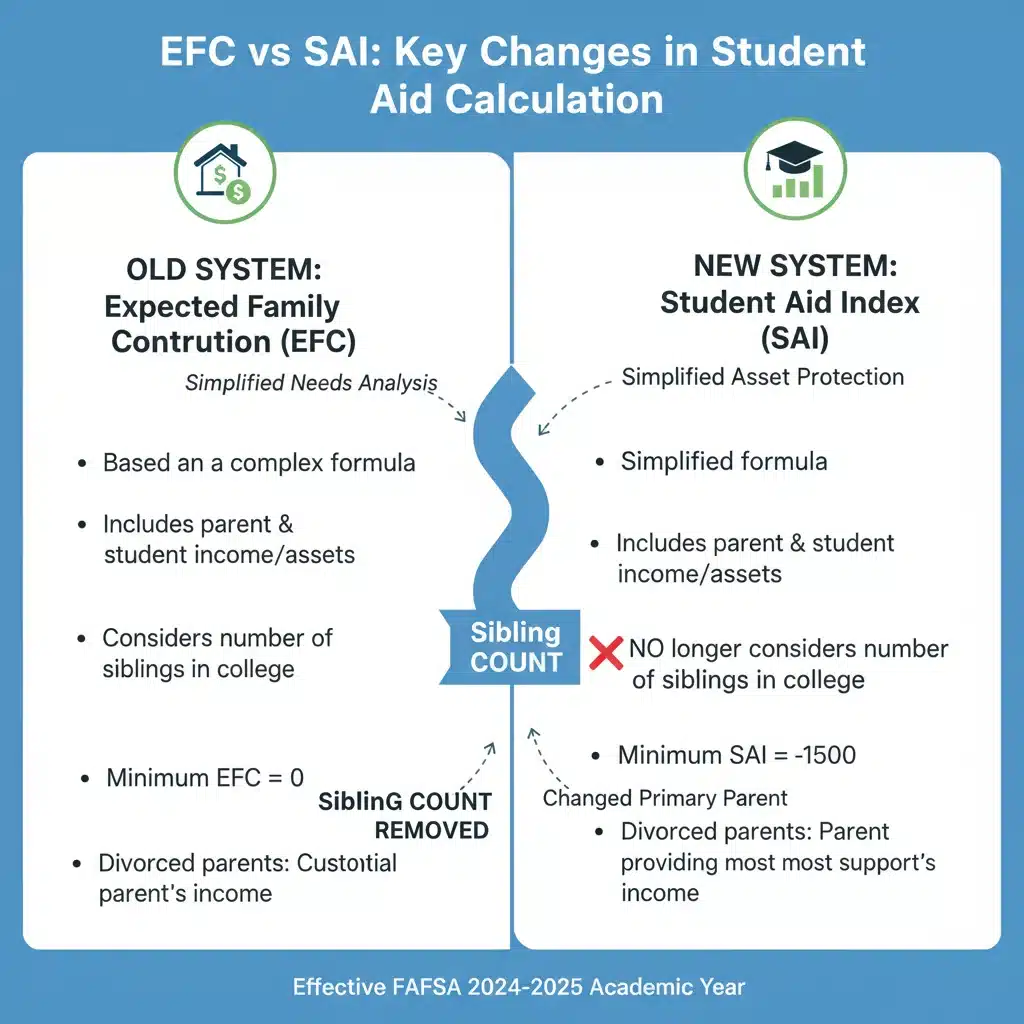
Perhaps the most significant of the FAFSA changes 2026 is the replacement of the Expected Family Contribution (EFC) with the Student Aid Index (SAI). While both are indices used to determine a student’s financial need, the SAI represents a fundamental shift in how that need is assessed.
What is the Student Aid Index (SAI)?
The SAI is a new eligibility index that colleges use to determine how much federal student aid a student is eligible to receive. Unlike the EFC, which could not go below zero, the SAI can be a negative number, ranging from -1500 to 999999. A negative SAI indicates a higher level of financial need, potentially allowing students to qualify for more grant aid.
Key Differences Between EFC and SAI:
- Negative SAI: As mentioned, the ability for the SAI to be negative is a major change, aiming to better identify students with the greatest financial need.
- Family Size: The new formula for SAI will rely on federal tax information (FTI) transferred directly from the IRS, which will automatically account for family size based on tax dependents. This is a simplification but also removes the flexibility to manually adjust family size as was sometimes possible with EFC.
- Number of Students in College: This is a critical change. Under the old EFC methodology, having multiple children in college simultaneously significantly reduced the EFC for each student. The new SAI formula eliminates this benefit. Each student’s SAI will be calculated independently, regardless of how many siblings are also attending college. This particular FAFSA change 2026 could have a substantial impact on middle-income families with multiple children pursuing higher education.
- Child Support: Child support received will now be reported as an asset of the recipient, rather than as untaxed income. This change could potentially lower a family’s SAI, increasing aid eligibility.
- Small Business and Farm Assets: This is another area undergoing significant revision. We’ll explore this in detail in the next section, as it’s a crucial FAFSA change 2026 for many families.
Understanding these core differences is paramount for families trying to project their financial aid eligibility under the new FAFSA changes 2026. The shift from EFC to SAI is more than just a name change; it’s a re-evaluation of financial need.
Impact on Small Businesses and Family Farms
One of the most talked-about FAFSA changes 2026 involves how small businesses and family farms are treated in the aid calculation. Historically, these assets were often excluded or given preferential treatment. The new rules aim for a more consistent approach, which could have varying impacts.
New Rules for Reporting Assets:
Under the FAFSA changes 2026, the net worth of a business or farm must be reported as an asset if the family owns more than 50% of the business and it has more than 100 full-time employees. However, for smaller businesses and family farms (those with 100 or fewer employees), the net worth must now be reported as an asset, regardless of whether it provides primary support for the family. This is a significant departure from previous rules where, for many small businesses and family farms, their value was not included in the EFC calculation.
Potential Implications:
- Increased SAI for Some: Families who own small businesses or farms that previously were not counted as assets may see a higher SAI, potentially reducing their eligibility for need-based aid.
- Valuation Challenges: Accurately valuing a small business or farm can be complex and may require professional appraisal, adding an additional step to the FAFSA process.
- Strategic Planning: Families with these types of assets will need to engage in careful financial planning to understand the impact and explore strategies to mitigate any negative effects on aid eligibility. This might include reviewing business structures or investment strategies well in advance of applying for aid.
For families whose wealth is tied up in these types of assets, understanding this specific FAFSA change 2026 is absolutely critical. It requires a more detailed approach to asset reporting than in previous years.
Divorced or Separated Parents: A New Approach
The FAFSA changes 2026 also bring a significant alteration to how financial information is reported for students whose parents are divorced or separated. This aims to simplify the process and align it more closely with the custodial parent concept.
"Primary Support" Rule Replaced:
Previously, the FAFSA required the financial information of the parent with whom the student lived the most during the past 12 months, or the parent who provided more than 50% of the student’s financial support. The new FAFSA changes 2026 simplify this: the parent who provides the most financial support is no longer the determining factor. Instead, the FAFSA will require financial information from the parent who provides the "greater portion of the student’s financial support" and with whom the student lived for the greater number of days during the 12-month period ending on the FAFSA application date. If this is unclear or equal, then the parent who provided more financial support will be used.
More specifically, the FAFSA changes 2026 will now require the financial information of the parent who provided the most financial support to the student during the 12 months preceding the FAFSA application, regardless of where the student lived. This is a subtle but important distinction that could shift which parent’s income and assets are reported.
Implications for Families:
- Potential for Different Parent to Report: Depending on the financial arrangements, this could mean a different parent’s income and assets are used for the FAFSA calculation than in previous years.
- Communication is Key: Divorced or separated parents will need to communicate effectively to determine whose financial information should be reported to ensure accuracy and maximize aid eligibility.
- Reviewing Custody Agreements: In some cases, families might need to review their custody or divorce agreements to understand the implications of these FAFSA changes 2026 on their financial aid prospects.
This specific FAFSA change 2026 underscores the importance of understanding the precise wording of the new guidelines to avoid errors that could negatively impact aid.
Federal Pell Grant Expansion: A Ray of Hope
Amidst the complexities of the FAFSA changes 2026, there’s good news for many students: the expansion of Federal Pell Grant eligibility. The Pell Grant is a cornerstone of federal student aid, offering need-based grants that do not need to be repaid.
Key Aspects of Pell Grant Expansion:
- Income-Based Eligibility: The new FAFSA will use federal poverty levels to determine eligibility for the maximum Pell Grant. Students whose family income is below a certain percentage of the federal poverty line will automatically qualify for the maximum Pell Grant.
- Automatic Qualification: Some students will automatically qualify for a maximum Pell Grant based on their or their parents’ adjusted gross income (AGI) in relation to the federal poverty line.
- Increased Access for More Students: Even those who don’t qualify for a maximum Pell Grant might find themselves eligible for a partial Pell Grant under the new methodology, thanks to changes in the SAI calculation and a new "minimum Pell" eligibility.
- Year-Round Pell: While not new, the continued availability of year-round Pell Grants allows eligible students to receive up to 150% of their scheduled Pell Grant award over an academic year, enabling them to accelerate their studies.
The expansion of Pell Grant eligibility is a significant positive outcome of the FAFSA changes 2026, offering more financial support to a broader range of students, particularly those from low-income backgrounds. This is a crucial area to investigate as you prepare your FAFSA application.
Strategies for Maximizing Your Financial Aid Eligibility
Navigating the FAFSA changes 2026 requires a proactive and informed approach. Here are some key strategies to help you maximize your personal financial aid eligibility:
1. Understand the Student Aid Index (SAI) Calculation:
Familiarize yourself thoroughly with how the SAI is calculated. Pay close attention to how your income, assets, and family size will impact this new index. If you have multiple children in college, be aware that the previous benefit of having more than one child in college simultaneously is now eliminated in the SAI calculation. This means each child’s aid package will be assessed independently, potentially leading to a higher out-of-pocket cost for families with multiple students. This FAFSA change 2026 is critical for multi-student households.
2. Strategic Asset Management:
Review your family’s assets, especially if you own a small business or a family farm. Understand how these assets will now be reported and whether their inclusion will significantly impact your SAI. Consider consulting with a financial advisor to explore strategies for asset allocation that are FAFSA-friendly, keeping in mind that any significant asset restructuring should be done well in advance of applying. Assets are generally assessed as of the day you complete the FAFSA, so timing can be crucial. This is a key area impacted by the FAFSA changes 2026.
3. Income Planning:
The FAFSA uses "prior-prior" year income. For the 2026-2027 FAFSA, this means your income from the 2024 tax year will be used. If you anticipate a significant change in income (e.g., job loss, career change, retirement), understand that the initial FAFSA may not reflect your current financial situation. In such cases, you may need to work with the financial aid office at your chosen institution to request a professional judgment review, explaining your special circumstances. Proactive income planning can help mitigate unexpected impacts from the FAFSA changes 2026.
4. Communicate if Divorced/Separated:
If your parents are divorced or separated, ensure clear communication about whose financial information will be reported on the FAFSA. Refer to the updated guidelines on which parent should apply based on who provides the majority of financial support. Misunderstandings in this area can lead to delays or incorrect aid calculations. The FAFSA changes 2026 have specific guidelines here that must be followed precisely.
5. Complete the FAFSA Early and Accurately:
Even with the simplifications, errors can occur. Fill out the FAFSA as soon as it becomes available (typically October 1st for the upcoming aid year). Submitting early increases your chances of receiving institutionally funded aid, as some colleges have limited funds distributed on a first-come, first-served basis. Double-check all information, especially income and asset figures transferred directly from the IRS Data Retrieval Tool (DRT) – though this process is becoming more automated, verification is still important. Accuracy is paramount with the FAFSA changes 2026.
6. Explore All Aid Types:
Remember that the FAFSA primarily determines eligibility for federal and some state aid. Don’t neglect other sources:
- Scholarships: Actively search for and apply to private scholarships. These are "free money" that does not need to be repaid and can significantly reduce your college costs.
- State Aid: Many states offer their own grant and scholarship programs, often with separate application processes and deadlines.
- Institutional Aid: Colleges themselves offer grants and scholarships, both need-based and merit-based. Some require supplementary applications in addition to the FAFSA.
7. Appeal if Necessary:
If your financial situation has changed significantly since the tax year used for the FAFSA, or if you believe your aid package doesn’t accurately reflect your need, don’t hesitate to appeal to the financial aid office. This is known as a "professional judgment" request. Be prepared to provide documentation to support your appeal. Understanding the FAFSA changes 2026 can help you articulate your case more effectively.

Common Misconceptions and Clarifications
With significant changes like the FAFSA changes 2026, misconceptions are bound to arise. Let’s clarify some common points:
- "I won’t qualify for aid." Many families mistakenly believe they earn too much to qualify for any financial aid. The FAFSA is used for all types of federal aid, including unsubsidized loans, which are available regardless of need. Furthermore, changes to the Pell Grant eligibility mean more students may qualify for grants than before. It’s always worth applying.
- "The FAFSA is too complicated." While historically complex, the FAFSA changes 2026 aim for simplification. The number of questions has been significantly reduced, and the process of importing tax information directly from the IRS is intended to make it quicker and easier.
- "My assets will disqualify me." While assets are considered, not all assets are counted. Retirement accounts (like 401ks and IRAs) are generally excluded. The impact of assets on your SAI might be less than you think, especially for moderate asset levels. For small businesses and family farms, while they are now included, their net worth might not drastically alter your overall aid eligibility depending on other factors.
- "Only low-income students get aid." This is false. While need-based aid heavily favors low-income students, merit-based scholarships and federal student loans are available to a wider range of income levels. The FAFSA changes 2026 are designed to expand aid access, not restrict it.
Dispelling these myths is crucial for encouraging all eligible students to apply for financial aid and to fully grasp the implications of the FAFSA changes 2026.
The Future of Financial Aid: Beyond 2026
The FAFSA changes 2026 are part of a larger, ongoing effort to reform federal student aid. While these changes are substantial, it’s important to recognize that the financial aid landscape will continue to evolve. Stay informed by regularly checking the official Federal Student Aid (StudentAid.gov) website and your chosen colleges’ financial aid pages.
Future considerations might include further streamlining of the application, adjustments to asset protection allowances, and responses to economic shifts. Advocacy for students and families continues, pushing for policies that make higher education more affordable and accessible for everyone. The FAFSA changes 2026 are a significant step in this direction, but not the final one.
Conclusion: Embrace the FAFSA Changes 2026
The FAFSA changes 2026 represent a monumental shift in how federal student aid is calculated and distributed. While the transition may present new challenges, particularly for families with multiple children in college or those owning small businesses and farms, the overarching goal is to simplify the process and expand access to aid for more students. Understanding the move from EFC to SAI, the new asset reporting rules, and the updated guidelines for divorced parents is critical.
By taking a proactive approach, staying informed, and strategically planning, you can navigate these FAFSA changes 2026 effectively. Remember to complete your FAFSA accurately and on time, explore all available aid sources, and don’t hesitate to communicate with financial aid offices if your circumstances are unique. Your educational aspirations are within reach, and with a solid understanding of the FAFSA changes 2026, you are well-equipped to maximize your financial aid eligibility and achieve your academic goals.
Start preparing now for the 2026-2027 FAFSA cycle. The more informed you are, the better positioned you’ll be to secure the financial support needed for a successful college experience. The FAFSA changes 2026 are here to stay, and mastering them is key to unlocking your educational future.